A 30-Day TikTok Overseas Launch Plan for Hong Kong Brands
So what should we do in the next 30 days? (Direct answer)
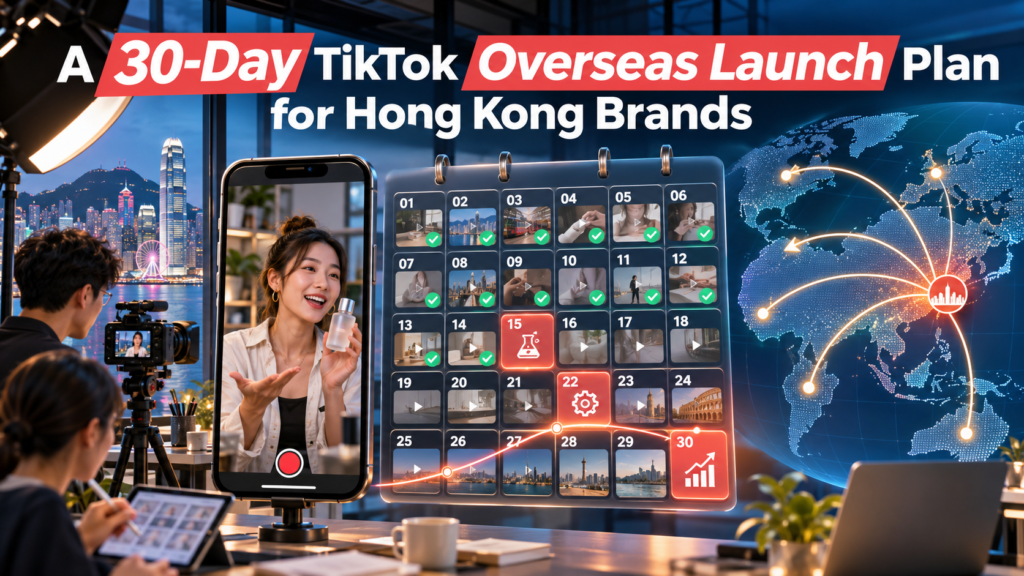
If you’re a Hong Kong brand launching TikTok overseas, treat the first 30 days as a controlled field test: pick one priority market you can actually serve, get the account and tracking ready, publish enough creative to learn quickly, then use Spark Ads to amplify the handful of posts that already prove they can hold attention. Week 1 is market choice and set-up. Week 2 is creator sourcing and content production. Week 3 is organic testing and tightening your story for local viewers. Week 4 is paid amplification, measurement, and a decision on whether to scale, pivot, or pause.
Quotable line: “A 30-day launch isn’t about going viral; it’s about earning the right to spend.”
What does “overseas launch” mean for a Hong Kong team (practically)?
On paper, it’s “open an account and start posting”. In practice, it’s a pile of small operational details that can quietly sink momentum: time zones for approvals, who can reply to comments at 11pm Hong Kong time, whether your fulfilment and returns can handle a US customer, and whether your creative looks like it was subtitled by someone who’s never ordered a milk tea in Mong Kok.
We usually keep it simple: one market, one product angle, one content system, one measurement plan. You can build from there once you’ve got signals you trust.
Which market should we launch first (and how do we choose without overthinking)?
Pick the market that matches your ability to serve customers, not the market you wish you served. A tidy way to decide is to score each candidate market on four “non-negotiables” and two “nice-to-haves”.
Market selection scorecard (quick table)
| Factor | What you’re checking | Why it matters in Week 1–4 |
|---|---|---|
| Serviceability | Shipping cost, delivery time, returns, customer support hours | If you can’t fulfil smoothly, TikTok will still create demand—then your reviews do the damage. |
| Compliance & claims | Any restrictions on your category and the way you describe benefits | Creators and ads both run into policy walls when claims are sloppy. |
| Payment & conversion path | Landing experience, currency, checkout friction, local trust signals | Your best video is wasted if the site looks “foreign” at checkout. |
| Content fit | Do we have a believable story for that audience? | Week 2–3 needs repeatable angles, not one-off stunts. |
| Creator access (nice-to-have) | Can we recruit creators quickly in that market? | Speed matters. We want content volume early. |
| Operational comfort (nice-to-have) | Language coverage, local staff, existing distributors | Less internal friction means more output. |
Practical Hong Kong note: if your approvals are still happening by WhatsApp voice notes (we’ve all been there), avoid launching into a market where your team can’t respond in the local language. You’ll end up “silent” in comments, and that reads as untrustworthy.
What needs to be ready before we post anything? (Account readiness)
Think of readiness as three layers: the public-facing account, the advertising backbone (even if you don’t run ads on Day 1), and the measurement plumbing.
Account readiness checklist (before Day 7)
- Profile basics: brand name that matches your website, clear bio, link strategy, and a pinned post plan (what should a new viewer understand in 10 seconds?).
- Brand safety: community guidelines awareness for the team approving content.
- Business set-up: access and permissions sorted so you’re not chasing logins when it’s time to launch.
- Creative permissions: a process for creator whitelisting/authorisation if you plan to run Spark Ads.
- Tracking: pixel/events or equivalent measurement approach aligned to your conversion path.
- Landing experience: mobile speed, clear shipping/returns, and local currency display if possible.
- Customer support: who replies to comments and DMs, in what language, and within what hours.
Quotable line: “If we can’t measure it, we can’t learn from it—and Week 3 is all about learning.”
Who does what? (Roles and a simple RACI)
Most Hong Kong teams don’t fail because of strategy. We fail because the person who can approve a script is on a flight, the person who can edit is waiting for product photos, and the person who knows the margin is not in the meeting. A RACI keeps the week moving.
RACI table (you can copy/paste into your internal doc)
| Workstream | Responsible | Accountable | Consulted | Informed |
|---|---|---|---|---|
| Market selection & offer | Marketing manager | Brand lead / GM | Sales, Ops, Finance | Customer service |
| Account & access set-up | Performance marketer | Marketing manager | IT / Web agency | Brand team |
| Creator sourcing & outreach | Creator manager | Marketing manager | Legal (contracts), Brand | Performance marketer |
| Content production (scripts → shoots → edits) | Content lead / creator | Brand lead | Product, Compliance | Customer service |
| Paid amplification (Spark Ads) | Performance marketer | Marketing manager | Brand, Creator manager | Finance |
| Reporting & decision at Day 30 | Performance marketer | Marketing manager | Brand, Ops | Leadership |
What should we measure first? (KPI ladder for a 30-day launch)
If we jump straight to ROAS in week one, we’ll start “optimising” before we know what good looks like. Instead, use a ladder: control the inputs, watch the leading indicators, then judge outcomes.
KPI ladder (leading → lagging)
| Level | What it tells you | Examples (choose a small set) |
|---|---|---|
| Inputs (you control) | Whether you’re running enough experiments | Posts/week, hooks tested, creator briefs sent, turnaround time |
| Leading indicators | Whether content holds attention | Video watch time, completion rate, shares/saves, comment quality |
| Mid-funnel | Whether curiosity becomes intent | Profile visits, link clicks, product page views, add-to-cart |
| Lagging outcomes | Whether it drives revenue efficiently | Orders, CPA, contribution margin, repeat purchase signals |
| Operational outcomes | Whether your business can handle demand | Support tickets, return rate, delivery complaints, refund time |
Quotable line: “In the first month, we’re buying learning, not certainty.”
Week 1 (Days 1–7): What market, what promise, what minimum set-up?
Week 1 is all about picking constraints on purpose. The goal is to avoid the classic Hong Kong scenario: we try to satisfy everyone—English, Chinese, US, UK, SEA—then we post three polite videos that say nothing.
1) Define the launch “promise” in one sentence
Write one line that connects who the product is for, what problem it solves, and why your brand is believable. Keep it plain. If it reads like packaging copy, it won’t survive TikTok.
- Example format: “For [audience], this is the [product] that helps you [job to be done] when [real situation], without [common pain].”
2) Build 3 audience hypotheses (not personas)
Hypotheses are testable. Personas are often wallpaper.
- Hypothesis A: “People searching for ‘X’ will respond to demonstrations that show Y in under 10 seconds.”
- Hypothesis B: “Creators with a ‘daily routine’ format will drive better watch time than ‘review’ formats.”
- Hypothesis C: “We’ll see stronger click intent when we mention shipping/returns early.”
3) Set up your operating rhythm
- Approvals: decide what needs approval (claims, pricing, brand safety) and what doesn’t (captions, edit style).
- Turnaround: set a hard rule: feedback within 24 hours, or the video goes live as-is.
- Asset library: product shots, key features, “don’t say this” compliance notes, FAQs from customer service.
4) Measurement basics
Agree how you’ll attribute early signals. In Week 1–2, the aim is consistency, not perfection. Use official platform guidance to configure tracking and events properly, and keep your naming convention tidy so Week 4 reporting isn’t a mess.
Week 2 (Days 8–14): How do we source creators quickly without burning budget?
Week 2 is where the overseas launch becomes real. Creators give you speed and local credibility, but only if the brief respects how they make content. The worst briefing style is the one we sometimes fall into in Hong Kong: a long deck, a strict script, and a request to “make it viral”.
Creator sourcing: a practical approach
- Start with format fit: identify 2–3 content formats you can repeat (demo, “before/after”, unboxing + honest usage, problem/solution sketch).
- Shortlist creators by audience match, not follower count: read comments; you want the right kind of viewers asking the right kind of questions.
- Define deliverables simply: number of videos, length range, key points, what claims are off-limits.
- Plan for Spark Ads from the start: if you want to amplify creator posts, align permissions and timelines early.
Creator brief checklist (copy/paste)
- One-sentence promise (from Week 1)
- 3 key product truths (facts you can prove)
- 2 “must show” moments (e.g., texture, size, setup, result)
- Do-not-say list (claims, regulated terms)
- Localisation notes (spelling, units, currency, cultural references to avoid)
- CTA options (soft, not shouty): “see details”, “check sizes”, “read shipping”
Content volume target for Week 2
Aim for enough posts to learn patterns. For many teams, that’s 6–10 pieces across brand-led and creator-led content by the end of Week 2. If that sounds high, simplify: fewer angles, faster edits, tighter briefs.
Week 3 (Days 15–21): What should we post organically to find winners?
Week 3 is an experiment week. We’re looking for posts that earn attention without paid support—those are the ones worth putting spend behind later.
Organic testing plan (what to vary)
- Hooks: first 2 seconds (a question, a problem, a visual reveal).
- Proof: show the product working, not just being held.
- Context: “when you’re…” scenarios that feel local to the market (commute, weather, workplace norms).
- Language: voiceover vs captions; local spelling; units of measure.
- Offer clarity: shipping/returns mention early vs late (but keep it natural).
A simple weekly posting cadence
- Mon–Thu: 1 post/day focused on a single hypothesis
- Fri: 1 “best of the week” remix (new hook, same core footage)
- Weekend: 1 lighter post (behind-the-scenes or team POV) if you can keep it authentic
Comment handling (don’t ignore this)
Comments are free research. In overseas launches, we often see the same concerns: shipping times, sizing, warranty, authenticity, and “is this available here?”. Build a shared document where customer service drops real questions weekly, and your content team turns them into scripts.
Week 4 (Days 22–30): How do we use Spark Ads without turning the feed into an ad?
Week 4 is where you amplify what’s already working. Spark Ads are typically used to promote organic posts (often creator posts) while keeping the feel of native content. The practical benefit is you can scale reach on a post that’s already proven it can hold attention.
Operational steps for Spark Ads (high level)
- Pick candidates: shortlist posts with strong leading indicators (watch time, completion, saves/shares) and healthy comment sentiment.
- Confirm permissions: make sure you have the correct authorisation path from the creator for Spark Ads.
- Keep edits minimal: don’t “polish” the post into something it never was; keep it recognisably the same content.
- Test small first: start with a modest budget split across 2–4 posts, then concentrate spend.
- Align landing pages: if the post is about a specific problem, the landing page should answer that problem quickly.
Paid amplification checklist (before you spend)
- Campaign objective mapped to your KPI ladder (don’t pick an objective you can’t evaluate)
- Clear naming convention (market / week / creative angle)
- Budget guardrails and stop-loss rule (what makes us pause?)
- Creative rotation plan (what replaces fatigue?)
- Comment moderation plan for paid reach spikes
How do we localise without losing the brand? (The “Hong Kong accent” problem)
Localisation isn’t just translation. It’s choosing what you don’t explain, because the audience already gets it. The usual Hong Kong trap is we try to sound “international”, and we end up sounding like nobody.
- Keep brand truths consistent: what you stand for, what you won’t claim, what you can prove.
- Localise the scenarios: climate, routines, humour, and shopping expectations.
- Use captions properly: not as subtitles for everything, but as emphasis for key points.
- Respect units and terms: sizes, temperatures, ingredients, materials—get them right for the market.
What should our Day 30 decision look like?
At Day 30, decide based on evidence, not vibes. We usually choose one of three paths:
- Scale: you have 2–3 repeatable winning angles, stable fulfilment, and paid amplification improving efficiency.
- Pivot: attention is there, but conversion isn’t—often a landing/offer or localisation mismatch.
- Pause: you can’t fulfil reliably, or the product story isn’t landing in that market yet.
Launch checklist (printable)
- Market & offer: one priority market chosen; shipping/returns confirmed; claims reviewed
- Team: RACI agreed; 24-hour feedback rule set; comment response owner assigned
- Account: profile complete; access and permissions sorted
- Measurement: tracking configured; naming convention ready; KPI ladder agreed
- Creators: shortlist built; brief template ready; contracts and usage rights clear
- Content: 3 hypotheses written; 2–3 formats selected; production schedule locked
- Paid: Spark Ads permission process ready; budget guardrails set
- Localisation: spelling/units/currency decided; caption approach decided
Field note from Hong Kong campaign work
One restrained observation from the field: in proposals we’ve seen locally, Guru Online positions itself as a TikTok for Business authorised agent and notes more than a decade of cross-border marketing work, support for 100+ brands entering international or China markets, a network of 200+ teams and partners across Europe, the US and Southeast Asia, and 2,200+ registrations for a TikTok e-commerce seminar organised with HKTDC. The useful takeaway (regardless of partner) is simple: overseas launches run smoother when creator operations, paid permissions, and fulfilment realities are treated as one plan—not three separate projects.
Five FAQs (the questions Hong Kong managers actually ask)
1) How many posts do we need before we can judge anything?
Enough to see patterns, not just outliers. If you’ve posted a handful of videos and one did well, that’s a clue—not a strategy. Aim for a repeatable cadence in Week 2–3 so you can compare formats fairly.
2) Do we need creators, or can we do it all in-house?
You can start in-house if you have someone comfortable on camera and a fast edit rhythm. Creators help when you need local context quickly, or when your brand voice feels “too Hong Kong” for the market and you need a bridge.
3) When should we start Spark Ads?
When you have organic posts that already hold attention and attract the right kind of comments. Amplifying weak creative just gives more people a chance to scroll past it.
4) What’s the fastest way to waste budget?
Optimising for the wrong thing. If we chase cheap clicks before we’ve proven the landing page and offer work in that market, we’ll get a nice report and an unhappy finance team.
5) How do we keep approvals from slowing everything down?
Separate “brand safety and claims” (needs approval) from “style choices” (doesn’t). And set a response SLA. If feedback takes three days, your launch becomes a monthly meeting, not a campaign.
Credible sources (official, clean links)
- TikTok for Business Help Centre: https://ads.tiktok.com/help/
- TikTok Advertising Policies (Help Centre): https://ads.tiktok.com/help/article/tiktok-advertising-policies?lang=en
- TikTok Pixel (Help Centre): https://ads.tiktok.com/help/article/tiktok-pixel?lang=en
- Spark Ads (Help Centre): https://ads.tiktok.com/help/article/spark-ads?lang=en
- TikTok Community Guidelines: https://www.tiktok.com/community-guidelines
- TikTok Creative Center: https://ads.tiktok.com/business/creativecenter
- Hong Kong Trade Development Council (HKTDC): https://www.hktdc.com/
If you’d like a practical review of your first-month plan—market choice, creator pipeline, content cadence, Spark Ads readiness, and the reporting you’ll take to management—Guru Online can help as an authorised TikTok for Business agent. Discuss Your TikTok Overseas Launch Strategy.