Xiaohongshu Seeding for Hong Kong Brands: A Practical Playbook
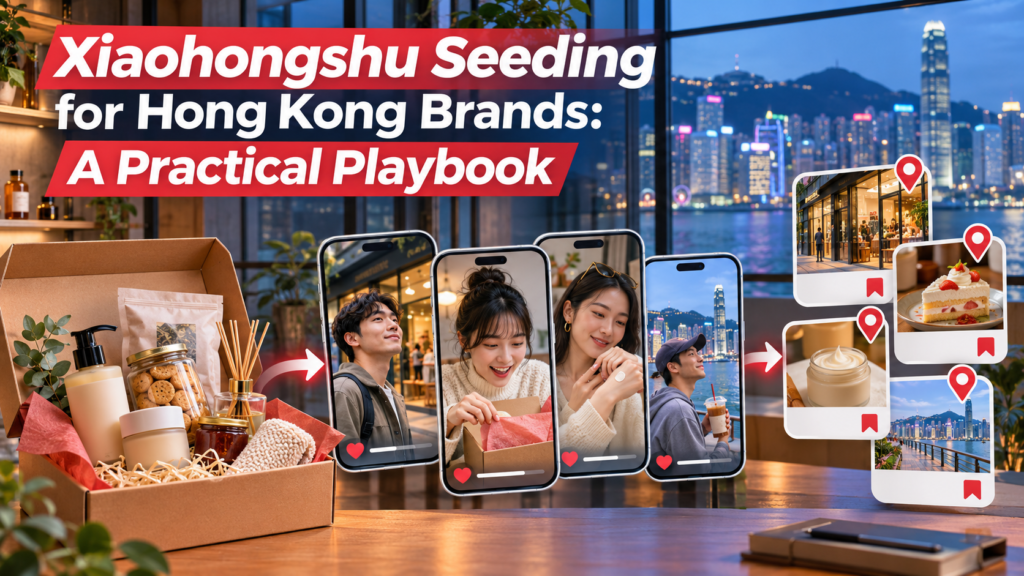
Xiaohongshu seeding is the steady work of placing genuinely useful “notes” (posts) so your brand shows up when people search and compare—before they come to Hong Kong, before they step into your shop, and often before they ask a friend. It’s part content planning, part creator management, and part customer service. Done well, it builds a searchable shelf of answers: what you sell, who it’s for, what it costs (when confirmed), where to go, and what to expect.
What do we actually mean by “seeding” on Xiaohongshu?
In Hong Kong meetings, “Xiaohongshu” sometimes gets treated like a prettier Instagram. That’s usually where the plan starts going off-track.
On RED (Xiaohongshu), seeding is closer to searchable word-of-mouth. People don’t just scroll; they look things up. They want a route, a shortlist, a price range they can trust, and a sense of whether something is worth the detour from Tsim Sha Tsui, Causeway Bay or West Kowloon.
Quotable explanation: A good RED note reads like a friend’s search result—specific, calm, and anchored in real experience.
Who is your Hong Kong brand really speaking to on RED?
Most Hong Kong brands have at least two overlapping audiences on Xiaohongshu:
- Mainland visitors planning a trip (often researching in Shenzhen/Guangzhou, then saving notes for later).
- Hong Kong-based Chinese-speaking consumers using RED for weekend planning, beauty research, “should I try this?” comparisons, and local discovery.
We see teams over-focus on demographics (“female 25–35”) and under-focus on the job-to-be-done (“I’ve got half a day in West Kowloon—what’s worth it?”). When you switch to intent, the workflow becomes clearer.
How do you pull audience insight without overthinking it?
You don’t need a six-week research project. Start with three fast inputs:
- Search reality check: On Xiaohongshu, search your brand name (in Chinese and English), your category, and your key locations. Screenshot the first two screens of results. What promises are competitors making? What questions keep appearing?
- Comment mining: Look at comments on top notes in your category. Copy the wording of real questions—these are future note titles.
- Frontline truth: Ask store staff (or CS) what people ask right before they buy or visit: payment, queue, booking, stock, shade matching, return policy, language, directions.
What keyword clusters should Hong Kong teams build first?
Think in clusters, not single keywords. A cluster is a set of related searches that all point to the same decision.
| Cluster | What it’s really about | Example Chinese queries (use as intent cues) | Good note angles |
|---|---|---|---|
| Location + category | “What’s near me that’s worth it?” | 铜锣湾 护肤 专柜;尖沙咀 下午茶 推荐;中环 香水 小众 | Neighbourhood shortlists; “walkable route” notes; “first-time visit” guides |
| Trip planning | “I’m visiting—help me plan” | 香港 周末 好去处;香港 一日游 路线;香港 必买 清单 | Half-day itineraries; “rainy day” plans; family-friendly picks |
| Comparison | “Help me choose” | 和XX 对比;值不值得买;香港 专柜 价格 | Fair comparisons; “who it suits”; “what I’d pick for…” |
| Problem → solution | “I’ve got a specific need” | 敏感肌 适合;油皮 面霜 推荐;香港 湿度 护肤 | Problem-led notes with clear boundaries (what it won’t solve as well) |
| Action + friction | “Can I actually do this easily?” | 怎么预约;要排队吗;可以支付宝吗;有中文服务吗 | Operational Q&A notes; “how to get there” + “what to bring” |
Small but important Hong Kong detail: location terms matter more than teams expect. People really do search “尖沙咀 / 铜锣湾 / 西九龙 / 启德” as part of the decision, especially when they’re stitching multiple stops into one day.
How do you choose between KOLs, KOCs and your own account?
For seeding, we usually separate jobs like this:
- KOLs: create high-clarity, high-trust “anchor” notes—formats people save (routes, comparisons, store experiences).
- KOCs: fill long-tail searches with relatable detail and natural language. Often better for comment quality, not just volume.
- Your official account: maintain factual notes and answer repeat questions without drifting into corporate copy.
If budget is tight, don’t buy “more creators”. Buy coverage: a small set of creators across distinct keyword clusters, plus the operational time to manage comments and updates.
What should go into a KOL brief without strangling the creator’s voice?
Hong Kong teams often over-brief on slogans and under-brief on the details that make a RED note useful. The brief should protect facts, not force tone.
KOL brief checklist (practical version):
- Non-negotiable facts: address, floor/unit, opening hours (as of shoot day), booking method, payment types accepted (only what you can confirm), and any restrictions.
- What to show: entry point, signage, queue process, “first thing to do”, what the product/treatment feels like, what the staff actually asks you.
- What not to claim: anything the brand can’t verify on the day (medical claims, fixed discounts, guaranteed availability).
- Language cues: simplified Chinese caption if targeting Mainland visitors; include the local place names people actually use.
- Approval boundary: you can correct factual errors; you shouldn’t rewrite into brand copy.
- Disclosure: require appropriate collaboration disclosure in line with platform and local compliance expectations.
What does a good sample brief look like for a Hong Kong store visit?
Sample KOL brief (copy/paste):
- Objective: Seed practical discovery content that helps users decide whether to visit our Hong Kong location.
- Audience: Mainland visitors building a HK itinerary; HK-based Chinese-speaking users comparing weekend options.
- Key questions to answer: “Where is it?”, “Is it easy to find?”, “What should I do first?”, “Who is it for?”, “How much time should I budget?”
- Must-include facts (brand to provide): full address; nearest MTR exit; floor/unit; booking method; payment methods; peak/off-peak visiting tips; photo rules.
- Suggested note structure: 1) Hook (the problem you’re solving) 2) Getting there 3) The experience step-by-step 4) What I’d choose / who it suits 5) One honest watch-out 6) Comment prompt (“ask me about…”)
- Visual guidance: clear signage shot; entry shot; one close-up that proves you were there (receipt blurred if needed); avoid over-filtering.
- Keywords: choose 1 primary + 3 supporting from the cluster list; include at least one location term.
- Compliance: add collaboration disclosure; do not make medical/guarantee claims.
- What success looks like: saves + comments asking for route/booking/price range; profile clicks; store-direction questions; mentions in-store (“saw it on 小红书”).
Which note formats tend to work best for Hong Kong categories?
Don’t put every creator on the same format. Variety is what builds search coverage.
| Format | Best for | What makes it believable on RED |
|---|---|---|
| “First time visit” guide | Retail, services, attractions | Step-by-step flow; what surprised you; one practical tip |
| Neighbourhood route | Causeway Bay / TST / Central / West Kowloon clusters | Walking order; time budget; what to do if it rains |
| Comparison note | Beauty, wellness packages, product lines | Clear criteria; who each option suits; avoid trashing competitors |
| Problem → solution | Skincare, haircare, health & lifestyle | Specific problem; realistic expectations; boundaries (“not for…”) |
| Search maintenance Q&A | Anything with repeated questions | Short, direct answers; updated details; friendly comment replies |
How do you plan posting waves so the content doesn’t vanish after a week?
A common Hong Kong pattern: a big burst, then silence. The burst might look good on a report, but it doesn’t build a shelf.
We aim for two waves plus a maintenance layer. Wave one tests angles and keyword fit. Wave two doubles down on what gets saved and commented on, not just what gets liked.
What should a 30-day Xiaohongshu seeding plan look like?
| Days | Focus | What your team actually does |
|---|---|---|
| 1–3 | Search + competitor scan | Screenshot top results for brand/category/location; list repeated questions; draft 4–6 keyword clusters |
| 4–6 | Content territories | Choose 3–5 angles; assign formats; confirm what facts you can safely state (hours, payment, booking) |
| 7–10 | Creator selection + briefs | Shortlist KOL/KOC mix; align on shoot logistics; issue briefs with facts + boundaries; set approval rules |
| 11–18 | Wave one publishing | Publish mixed formats; monitor comments twice daily; log objections; adjust keyword usage and covers |
| 19–23 | Wave two optimisation | Brief follow-up notes for top clusters; publish a route or comparison if planning questions appear |
| 24–27 | Search maintenance | Publish/refresh Q&A notes; fill gaps where results are outdated or irrelevant; tidy your own account’s pinned content |
| 28–30 | Measurement + next month plan | Review by cluster + format; decide what to repeat, what to drop; update briefs based on comment learnings |
How do community replies and DMs change the results?
On RED, the comment section is often where the real decision happens. If people ask “怎么去?” or “要预约吗?” and nobody answers, you’re leaving intent on the table.
Reply rules we use in Hong Kong:
- Reply fast to practical questions (route, booking, payment, opening hours) and keep it plain.
- Match the user’s language. If they write simplified Chinese, reply in simplified Chinese.
- If something changed (hours, price, stock), say so. Don’t argue; update.
- When the same question appears three times, that’s a new note topic.
How do you connect seeding to store visits without making staff miserable?
If you have a physical location, prepare the frontline. Otherwise creators show up, film, and staff find out after the fact—never a good start.
Quick store-ops checklist:
- Confirm filming rules and peak hours with the store manager.
- Share a one-page FAQ with staff: where to send people, what to recommend, what not to promise.
- Decide how you’ll capture “I saw it on 小红书” mentions (a simple tally sheet is fine).
- If you’re using a QR, keep it stable for at least the campaign month so links don’t break.
What should you measure (beyond likes) if you want to run this properly?
Likes are visible, but they’re a weak planning signal on their own. For Hong Kong teams, the most useful metrics usually sit in three buckets: search presence, intent quality, and operational outcomes.
| What to track | What it tells you | How to capture it | Cadence |
|---|---|---|---|
| Search presence by keyword cluster | Are you discoverable where it matters? | Manual spot-checks + screenshot log of top results for priority terms | Weekly |
| Saves + “planning” comments | Real consideration (people keeping it for later) | Creator/brand post analytics + comment tagging | Twice weekly |
| Repeated objections | What’s stopping visits/purchases | Simple spreadsheet of comment themes | Weekly |
| Store/enquiry signals | Movement from content to action | Staff tally (“小红书” mentions), booking notes, QR scans, coupon codes (only if you already run them) | Weekly |
| Format performance | What to brief next month | Compare route vs experience vs Q&A notes; look at save/comment rate | End of month |
Observation box: three reported field facts (and nothing more)
Keep this as context, not a sales story:
- Guru’s proposal states that M+ gained 4,000 Xiaohongshu followers within four months.
- A reported LA MER KOL campaign recorded 300,000+ exposure and 6,000+ engagement.
- SOGO used 10 Hong Kong lifestyle KOLs and reported 3,800+ engagements.
What are the misconceptions we keep seeing in Hong Kong briefs?
- “It’s just a burst of influencer posts.” Without search maintenance and replies, you’re renting attention for a week.
- “One hero KOL will do it.” Search coverage usually comes from multiple angles, not one face.
- “We can copy Douyin scripts.” RED users punish anything that reads like a broadcast advert.
- “We’ll measure success by likes.” For many categories, saves and practical comments are the better early signal.
- “We can approve everything.” Correct facts, yes. But over-editing removes the native feel that makes notes work.
Field note from Hong Kong campaign work
One pattern we’ve learned at Guru Online: when a RED note includes one unglamorous detail—the nearest MTR exit, the lift to take, the best time to avoid queues—the comment section changes. People stop asking “where is it?” and start asking “which option should I pick?” That’s a healthier problem to have, and it’s usually where real intent shows up.
FAQs
1) Should we post in traditional or simplified Chinese?
If Mainland visitors are a priority, simplified Chinese is often the safer default for captions and titles. For Hong Kong locals, either can work, but consistency matters: mixed language can reduce clarity in search. In practice, many teams use simplified for discoverability, then reply in the user’s language.
2) How many notes do we need in the first month?
Plan for coverage, not a magic number. A workable month-one target is enough notes to cover your top 4–6 keyword clusters across at least 3 formats. If you can’t reply and maintain them, scale down.
3) Do we need an official account if we’re doing KOL seeding?
It helps, mainly for factual Q&A notes and for replying in a consistent voice. But don’t flood RED with brand posts. Use the account to support what creators seeded, and to keep practical information current.
4) What’s the fastest way to improve Xiaohongshu search results for our brand?
Fix the basics first: consistent brand name in Chinese/English, a clear “how to get there” note, and at least one note answering the top three repeat questions from comments. Then brief creators to target the missing keyword clusters.
5) What should we do if negative comments start ranking?
Don’t panic-reply. Check whether the complaint is factual, whether it’s a one-off or repeated, and whether there’s an operational fix. Respond calmly, correct what’s wrong, and create a maintenance note that clarifies the misunderstanding with specifics.
Useful primary sources (for your internal reference)
- Xiaohongshu Pugongying (蒲公英) creator cooperation overview: https://pgy.xiaohongshu.com/role-introduce
- Xiaohongshu Open Platform: https://redopen.xiaohongshu.com/
If you’d like a second pair of eyes on your RED plan (keywords, briefs, measurement and the boring operational bits), we can help you review it without fuss. Request an AI Visibility Review.