The Hong Kong KOL and KOC Selection Checklist: 20 Checks Before You Sign
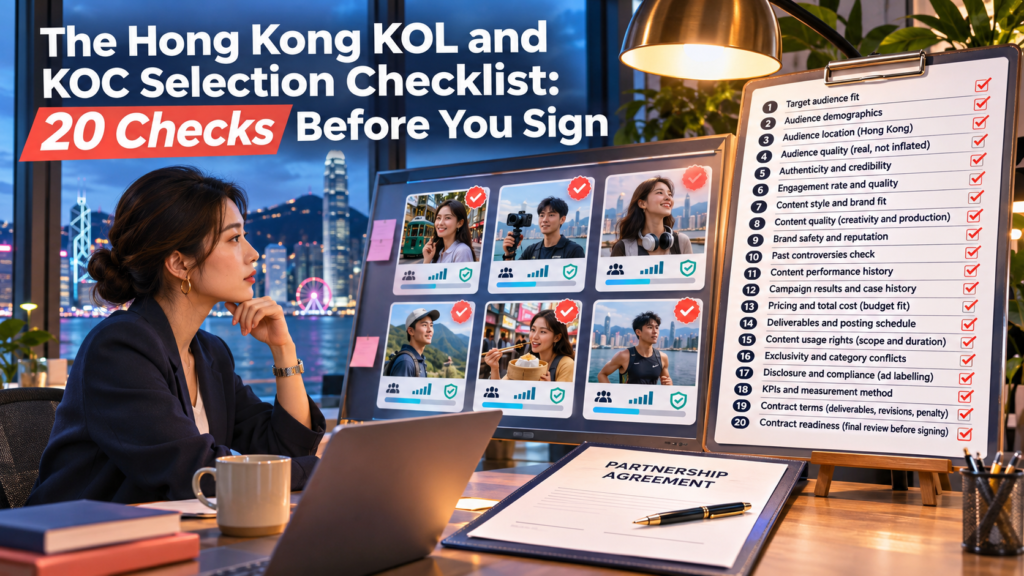
Selecting a Hong Kong KOL or KOC is not just a follower-count exercise. Before you sign, check audience fit, local relevance, engagement quality, brand safety, disclosure, creator usage rights, paid amplification permissions, deliverables, production risk and measurement. This checklist is built for brand managers working with bilingual briefs, WhatsApp negotiations, shopping mall activations, MTR or OOH tie-ins, agencies, MCNs and cross-border Shenzhen creators.
What should you check before signing a Hong Kong influencer contract?
You should check whether the creator can reach the right Hong Kong audience, produce the right content, disclose paid work clearly, grant the rights you need, and report results in a way your team can verify. A practical Hong Kong KOL selection checklist should also cover Cantonese and English nuance, holiday timing, category conflicts, account authenticity and whether paid amplification influencer permissions are ready before media goes live.
Use this rule of thumb: “A creator is not approved until the audience, content, contract and measurement all make sense together.” One strong area cannot compensate for hidden risk elsewhere.
Field note from Hong Kong campaign work
Guru Online often sees the cleanest approvals when creator roles are agreed before WhatsApp negotiations begin, not after the first draft arrives.
How does the 20-point checklist work?
Score each item from 0 to 2. Give 0 when evidence is missing or risky, 1 when it is acceptable but needs clarification, and 2 when it is clear, relevant and documented. Do not invent market benchmarks; compare each creator against your campaign goal, category, past content, audience evidence and the other shortlisted creators.
Interpret the total cautiously:
- 32–40: Strong shortlist candidate, subject to final contract and compliance review.
- 24–31: Usable with conditions, such as tighter briefs, limited rights or manual reporting checks.
- Below 24: High-risk unless the creator has a very specific role, such as niche UGC or event attendance.
1. Audience location fit is proven
Check whether the audience is genuinely relevant to Hong Kong, not just broadly Chinese-speaking. Ask for audience location screenshots and look for unexplained spikes in non-target markets. For cross-border Shenzhen creators, confirm whether their followers can realistically buy, visit or engage with the Hong Kong offer.
2. Audience language matches the brief
Hong Kong campaigns often need Cantonese, Traditional Chinese and English in the same content system. Review whether the creator naturally switches tone without sounding translated. A bilingual brief should specify must-use terms, banned claims and whether captions, subtitles and story frames need both languages.
3. The creator has local cultural relevance
Look for Hong Kong-specific cues: MTR habits, mall culture, cha chaan teng references, local school calendars, typhoon-day behaviour, payday timing and holiday shopping rhythms. Surface-level skyline shots are not enough. A KOC selection checklist should reward creators who understand the daily context of the audience.
4. The fake followers check is documented
A fake followers check should combine tools and human review. Look for sudden follower jumps, low story views relative to account size, repetitive usernames, irrelevant country clusters and engagement pods. No tool is perfect, so save screenshots and notes rather than relying on a single “authenticity” score.
5. Engagement quality is human and relevant
Read the comments. Real engagement includes questions, personal reactions, saves, shares and product-specific discussion. Weak engagement often looks like emoji strings, generic praise or comments from the same creator circles. Quality matters more than a tidy percentage.
6. Content style fits the campaign job
A polished fashion creator may not be right for a pharmacy education brief; a casual KOC may be ideal for first-use product explanation. Match the creator to a role: awareness, education, social proof, store visit, livestream support or UGC-style ad creative. This prevents one creator from carrying a job they were not built for.
7. Brand safety is reviewed manually
Scan past posts, comments, livestream clips and tagged content. Check sensitive topics, competitor mentions, profanity, medical claims, political adjacency and category suitability. In Hong Kong, also check whether humour or slang could read differently in Cantonese and English.
8. Product experience is credible
If the creator is expected to review, demonstrate or recommend, they need enough product experience to speak honestly. For beauty, wellness, food, finance and parenting categories, vague enthusiasm can create compliance and trust issues. Build sampling time into the schedule.
9. Category exclusivity is defined
Do not leave exclusivity to assumption. State the category, competitor list, blackout dates and whether exclusivity applies to posts, stories, livestreams, events and paid ads. A clean influencer contract Hong Kong teams can use should avoid broad restrictions that creators cannot reasonably accept.
10. Usage rights are specific
Creator usage rights should say where the brand can use the content, for how long, in which markets and whether edits are allowed. Separate organic reposting, website use, CRM, retail screens, mall displays, MTR/OOH adaptation and paid ads. Rights that sound “global and forever” often slow negotiation.
11. Paid amplification permission is clear
If the plan includes boosting creator content, allowlisting or partnership ads, confirm permissions before signing. Meta notes that advertisers can boost organic creator content as partnership ads when the setup is in place. The contract should name the ad account, duration, markets, approval flow and takedown process. (about.fb.com)
12. Disclosure wording is agreed
Disclosure Hong Kong influencer practice should be clear, early and easy to understand. The FTC advises disclosure when there is a material connection, including payment, free products or other value, and says disclosure should be hard to miss. For Hong Kong financial institutions, HKMA guidance also points to simple, clear labels or hashtags in influencer marketing. (ftc.gov)
13. Deliverables are counted precisely
List every post, reel, story frame, livestream mention, event attendance, draft, reshoot and reporting screenshot. In Hong Kong, missed details often happen around story frames, bilingual subtitles and mall-event attendance windows. Define whether “one video” includes cutdowns.
14. Creative approvals have enough time
Build in review rounds for legal, product, brand and Chinese copy. WhatsApp is useful for fast coordination, but final approvals should be captured in writing. For regulated or claims-sensitive categories, do not let a creator publish from a casual voice note.
15. Production risk is realistic
Check whether the creator needs a photographer, studio, helper, makeup, location permission or mall shooting approval. If the campaign is tied to Mid-Autumn, Christmas, CNY or 11.11, assume creator capacity tightens. Late product delivery can ruin even a good shortlist.
16. Agency or MCN roles are transparent
Clarify who negotiates, who invoices, who approves copy and who owns reporting access. Some MCNs protect creators well; others add delay without adding quality control. Ask whether you can speak directly to the creator before final approval.
17. Offline integration is feasible
If the campaign connects to MTR panels, OOH, pop-ups or shopping mall counters, check whether the creator can physically attend and create content on site. Confirm district, timing, crowd control and filming restrictions. A Causeway Bay visit is not the same as a weekday New Territories activation.
18. Tracking links and codes are ready
Do not wait until publication day to create UTMs, promo codes, landing pages or QR codes. Each creator should have traceable assets where possible. Make sure the naming convention works for your media, ecommerce and CRM teams.
19. Measurement definitions are agreed
Define reach, impressions, engagements, clicks, views, saves, shares and conversions before reporting. IAB guidance stresses transparency in how reach is measured, especially when “unique” audience measures are used. Your report should state data source and screenshot timing. (iab.com)
20. Post-campaign learning is required
Ask for raw screenshots, live links, content files, final captions, publication times and qualitative comment notes. The best learning is not only who performed, but why: content angle, audience fit, product role, timing or paid support. This feeds the next influencer vetting Hong Kong round.

Which outreach questions should you ask creators or agents?
Good outreach is specific but not aggressive. We usually get better answers when we explain the campaign role first, then ask for evidence.
- Can you share recent audience location and age screenshots?
- What percentage of your content is normally Cantonese, English or bilingual?
- Have you worked with direct competitors in the last few months?
- Are you represented by an agency or MCN for this negotiation?
- Can the brand reuse approved content organically? If yes, where and for how long?
- Are you open to paid amplification, partnership ads or allowlisting?
- What disclosure wording do you normally use for paid or gifted collaborations?
- How many review rounds are included before extra fees apply?
- Do you need support for filming, mall access, product testing or subtitles?
- What reporting screenshots can you provide after publication?
What red flags should stop or slow approval?
Red flags do not always mean “reject immediately,” but they should trigger a pause.
- Refusal to provide audience screenshots.
- Large follower jumps with no clear reason.
- Comments that look automated or irrelevant.
- Heavy competitor activity with unclear exclusivity.
- Claims that the creator can guarantee sales without a trackable plan.
- Resistance to clear ad disclosure.
- Vague usage rights language.
- No clarity on whether the agent, MCN or creator approves final content.
- Last-minute fee changes after deliverables are agreed.
- Poor responsiveness before signing; it rarely improves after payment.
How do examples show creator mix and role clarity?
Use examples to study structure, not to copy numbers blindly. A Vita Green campaign using 8 influencers should be assessed by separating each creator’s role: who educated, who gave lifestyle context, who created reusable assets and who supported retail or social proof. The key is to read impressions, reach and engagements against the assigned job, rather than ranking all 8 creators as if they had the same task.
A second useful reference is a Waterdrop campaign with 20 micro-influencers, 51,833 impressions, 47,301 reach and 7,437 engagements. Its lesson for Hong Kong teams is role clarity at scale: many smaller creators can cover more situations, but only if the brief keeps message, disclosure, content rights and reporting consistent. (junecom.ro)
What sources should your team keep on file?
Keep these clean URLs in your internal checklist folder:
- https://www.ftc.gov/business-guidance/resources/disclosures-101-social-media-influencers
- https://about.fb.com/news/2024/02/creator-marketplace-for-brands-and-creators-to-collaborate-on-instagram/
- https://www.iab.com/guidelines/audience-reach-measurement-guidelines/
- https://www.hkma.gov.hk/media/eng/doc/key-information/guidelines-and-circular/2023/20231220e2a1.pdf
What do brand managers usually ask?
Is a KOC safer than a KOL?
Not automatically. A KOC can feel more credible, but you still need audience evidence, disclosure, usage rights and reporting. Smaller accounts can also have fake engagement or unclear commercial habits.
Should we require both English and Cantonese captions?
Only if the audience and product journey need both. For Hong Kong, bilingual content often helps internal alignment, but forced English can weaken a naturally Cantonese creator’s voice.
Can we boost influencer content after it performs well?
Yes, if paid amplification rights and technical permissions were agreed in advance. Do not assume a creator will accept ad usage after seeing the post perform.
What belongs in an influencer contract Hong Kong checklist?
Include deliverables, deadlines, fees, exclusivity, disclosure, approval rounds, usage rights, paid media permissions, cancellation terms, reporting requirements and claim restrictions.
How many creators should we shortlist?
Shortlist more than you expect to sign, because conflicts, availability, usage rights and production timing will remove some candidates. Quality control matters more than filling a fixed quota.
If you want a second pair of eyes before signing, ask Guru Online for a creator vetting or selection review focused on audience fit, content risk, rights, disclosure and measurement readiness.